About the Shasta Historical Society
Formed in 1930 to interview the county's living pioneers, the Society now preserves, promotes and brings to life the history of Shasta County through its museum, research library, events and publications.
Who we are
A warm welcome from downtown Redding
The Shasta Historical Society is committed to the education and enrichment of the community through its museums, research library, community events and publications. Much of that record is now searchable online.
Alongside the research library, the Society runs free events through the year, including a monthly programme and a walking tour series, and publishes The Covered Wagon annually. Written by local authors and professional historians, its articles tell the stories of Shasta County and its people.
The largest non-university centre for historical research in California north of Sacramento, hosting more than 3,000 researchers, students and teachers each year.
Since 1930What drives us
Mission and vision
Mission
To actively preserve, promote, and bring to life the history of Shasta County. The Society encourages and inspires exploration of that history through exhibits, programmes, publications, collections and research services, so that visitors become witnesses to history and explore the dynamics of local heritage.
Vision (2023)
To become a professional facility where diverse interpretation and programming makes history exciting, visible and accessible to all. As an educational and research institution, the Society communicates and preserves our shared local history.
Core values
- Stewardship
- Education
- Preservation
- Community
Collections
What the museum and research library hold
Resources open to researchers, students, teachers and family historians.
- Over 40,000 photographs
- More than 5,000 books, pamphlets and vertical files
- Rare books
- Oral history recordings
- Pioneer family files and family histories
- Early marriage records
- Cemetery records
- Coroner's records, 1850–1935
- Shasta County census records
- Poll tax and registered voter records
- Early maps and early Redding city directories
- The Shasta College Museum Collection
History
The Society, step by step
From a chamber of commerce committee to a permanent museum and archive.
-
18 January 1930 — the Trails of '49 Committee
The Redding Chamber of Commerce brought more than twenty local leaders together on Yuba Street to preserve the county's history. The name recalled the many paths pioneers took into Shasta County during the Gold Rush. May Hazel Southern, daughter of pioneer Simeon Southern, was elected first president and served until 1939.
-
15 March 1930 — organised permanently
Lawyers Orr M. Chenoweth and Francis Carr submitted plans and by-laws to reconstitute the committee as the Shasta County Historical Society. They were adopted unanimously; within eighteen months membership stood at sixty.
-
Late 1930s — a new name
The organisation adopted its present name, the Shasta Historical Society.
-
1943 — the first Year Book
The Society launched its first publication. Two years later it was renamed The Covered Wagon, and it is still published today.
-
1951 — incorporated
The Society became a non-profit 501(c)(3) organisation, governed by a board of directors and run by full- and part-time staff and volunteers.
-
29 August 1976 — operations under one roof
The Society moved to the Redding Museum and Art Center at 72 Quartz Hill Road in Caldwell Park, combining its operations and archives in a single location for the first time.
-
1998 — a permanent home
After the Board began planning its own building in 1995 and approved a purchase the following year, the Society moved into 1449 Market Street in downtown Redding.
-
2013 — A Taste of History
The annual fundraiser was established at Turtle Bay Exploration Park and Museum, moving the next year to Shasta State Historic Park, where it is still held every spring.
Homes of the Society
The buildings
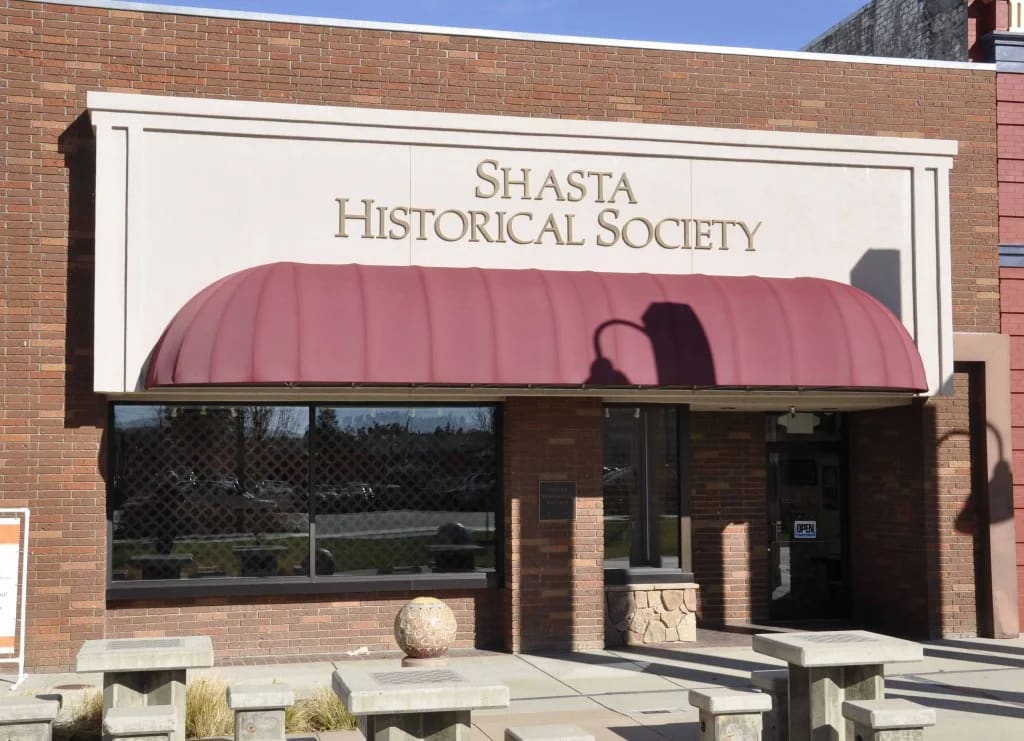
1449 Market Street, built 1902
Designed by local architect Matthew W. Herron and erected in 1902 by Shasta County pioneer Chauncey C. Bush Sr., known as the "Father of Redding". It began as a post office and had many lives after that: an assayer's office, a Chevrolet car agency, JCPenney's, a women's wear shop, a hardware store and a graphics store. In 1998 it became the Shasta Historical Society. The facility has a 4,400 square foot ground floor and a second-level archive section of roughly 1,100 square feet.
Before Market Street
Without premises of its own, the Society spent decades in borrowed rooms.
- The Chamber of Commerce's pagoda-style building on Yuba Street, which also stored the early archives
- The Golden Eagle Hotel from 1940, once the Society outgrew the Chamber building
- Directors' and members' homes through the 1950s, with archives split between the Chamber of Commerce and the County Recorder's Office
- The Carter House in Caldwell Park, then a shared space in the Museum of Art and History
- The Redding Museum and Art Center, 72 Quartz Hill Road, from 1976

Historic preservation
Preserving the record
Marking sites, collecting voices, and defending buildings and parkland since the Society's first weeks.
- February 1930: five of the county's most important historic sites chosen for marking with native boulders and inset bronze plaques, designed by the Shasta Union High School art class under J.P. Webb of Redding Iron Works. The first three were dedicated by 15 September 1931.
- 27 March 1930: President Southern and Mrs. Clara Archer travelled to Stillwater, now Mountain Gate, to record oral histories and collect photographs and ephemera, then broadened the effort to other county communities.
- 1938–1939: original scripted productions, California under Four Flags and the thirty-actor pageant A Romance of Pioneer Redding at the Golden Eagle Hotel.
- Late 1930s: the Society spearheaded restoration of the Courthouse Museum and parklands at Shasta State Historic Park, and attended its dedication on 12 June 1950.
- October 1940: second president Gertrude (Bell) Steger put the Society on record against a ballot measure permitting oil and gas leases in California state park lands. The measure was defeated.
- 1962: the Society campaigned to save the Carnegie Library on Yuba Street, deemed unsound by a city engineer. It was demolished in 1965 and replaced with a parking lot.
- Early 1990s: historic ledgers discarded by the Shasta County Recorder's Office were rescued, donated, preserved, digitised and indexed for research.
In print
Publications
Local history in books, newsletters and, since 2000, on DVD.
- The Covered Wagon
-
Launched in 1943 as the Year Book and renamed two years later. This annual collection gathers memories from then-living people alongside original historical research, and is still published today.
- The Stagecoach
-
A newsletter for the general membership, launched in January 1989 after California B. Quint donated the organisation's first computers. It carries Society news and historical articles.
- Place Names of Shasta County
-
Written by Gertrude (Bell) Steger, the Society's second president.
- Shasta County, California – A History
-
Rosena A. Giles' book, published by Biobooks of Oakland. Background research was a major Society project in 1949.
- Wintu Trails
-
Published by the Society in 1977, on the local Wintu tribe and, to a lesser degree, Shasta County.
- A History of Shasta County, California
-
Spearheaded in 1985 with the assistance of Hazel McKim and published by the Shasta County Book Commission. A detailed account of the county's history, including local family genealogies.
- Recent titles
-
The Wright Time, the story of the Pilgrim Congregational Church; Recipe Book for Cooks, a collection of pioneer recipes; and Faces of Shasta County, a collaboration with The Riverfront Playhouse in which actors portray prominent women and men from the county's past.
Founding detail
Who were the charter members?
Miss Alice M. Reading, Miss May Hazel Southern, Mrs. George B. Lowdon, Mrs. Edna Behrens Eaton, Charles Browne, Francis Carr, Lew Carrigan, Mr. and Mrs. B. F. Loomis, Charles Litsch, Mrs. Nettie Prehn, Mrs. Amelia Early, Mrs. Thyra Heffelfinger, Fred Dersch, James M. Bartlett and M. E. Dittmar.
What were the original purposes of the Society?
To obtain, preserve and perpetuate the early history of Shasta and other counties of northern California and their pioneers, and to identify and preserve places of historic and romantic interest. Since 1930, Trinity, Siskiyou and Modoc Counties have organised their own historical societies covering their areas.
Who spoke at the first meeting?
The Honorable Superior Court Judge James William Bartlett of Trinity County, a leading authority on Northern California history and a charter member. One of the committee's first acts was to write to the California Historical Society in Oakland for guidance on recording oral histories and preserving artifacts; that society in turn donated Shasta County material from its archives.
Members of
Affiliations


Explore Shasta County's history with us
Search more than 40,000 photographs and thousands of records online, or contact us about research, events and the grand re-opening.